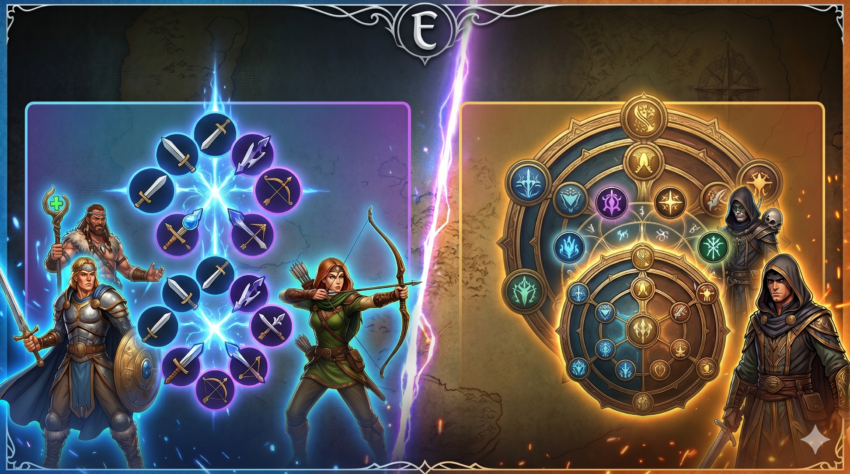
If you spent any real time on The Heroes Journey you already have a class combination in your head for Legends. Maybe you’re rebuilding your SK/Brd/Wiz from scratch. Maybe you’re convinced Nec/Mag/Bst still works with one pet. Maybe you’ve been theorycrafting something completely new based on the 560 possible combinations Legends confirmed.
Here’s the thing though. The multiclassing system you’re imagining is probably based on how THJ felt to play. And Legends might be a genuinely different experience at a mechanical level — not because it’s worse, but because it’s solving a completely different problem.
THJ existed to make one person powerful enough to solo content designed for forty. Legends is designed around four person groups and eight person raids with solo play supported alongside that. Same concept on the surface — pick three classes, play all three simultaneously. Completely different design target underneath. And that difference is probably going to show up in ways that surprise people who are coming in expecting THJ with an official license.
Why the Design Target Changes Everything
When you’re tuning a game for one player doing raid content you need passive systems doing a lot of heavy lifting. Procs firing automatically from all three classes without active management. Disciplines running on independent timers so three classes contribute simultaneously without blocking each other. Heals that don’t interrupt your melee loop. Cast times fast enough to weave spells between swings. All of that existed on THJ because one person can only actively manage so much at once and the game needed three classes contributing whether you were pressing buttons for them or not.
When you’re tuning a game for four players covering roles between them that math changes. Your tank doesn’t need passive healing procs from three different classes because someone in the group is covering the healing archetype. Your damage dealer doesn’t need automatic sustain from secondary class procs because the group composition handles that. The passive everything runs automatically underneath your primary class philosophy might not be what Legends needs to function — because Legends has other people filling those gaps.
Game Jawn confirmed the baseline difficulty is roughly 1999 EverQuest. Four man groups. Eight man raids. That combination of design decisions is probably the strongest signal we have about where Legends lands on the spectrum between THJ and classic EQ — and it suggests closer to classic than most THJ veterans are expecting.
What We Think Is Probably In
Independent discipline cooldowns between classes. This one we feel fairly confident about because without it multiclassing doesn’t really work at a fundamental level. If your three discipline pools share timers using a Monk discipline locks your Berserker disciplines and two of your three classes sit idle during any given combat window. That’s not three classes working together — that’s one class with two passengers. Some version of independent discipline functionality is probably in Legends because the alternative makes the whole premise feel broken.
Backstab from any position with any weapon. In a four player group where everyone is managing multiple class responsibilities simultaneously requiring correct mob positioning for Rogue backstab is a real friction point. We’d expect this quality of life change to survive because without it Rogue becomes significantly harder to play as a secondary or tertiary class in a group setting.
Archery working in melee range. This one matters enormously for Ranger viability as a multiclass component. On THJ bow shots in melee range checking Double and Triple Attack simultaneously with weapon swings was essentially Ranger’s entire value proposition as a tertiary class. Without it Ranger doesn’t have much of an identity in a multiclass system. We think it stays — but if it doesn’t the Ranger conversation is basically over before it starts.
Lifetaps critting. Core Shadow Knight identity that exists in some form in classic EQ regardless of THJ. We’d be surprised if this isn’t in Legends.
Some form of passive proc contribution. Procs are the mechanism that makes a class you’re not actively focused on feel like it’s still doing something. Without them secondary and tertiary class contributions become invisible in a way that makes three classes feel like one class with extra spell bars. We think some version of procs is in — the ceiling and stacking rules are the unknown.
Item upgrade progression. Already confirmed through the item merging system. Same philosophy as THJ’s legendary upgrade path — you’re progressing items over time rather than just replacing them with better drops. The concept carries over even if the implementation looks different.
What We Think Probably Isn’t
Global buffs that replace entire class identities. On THJ Cleric, Shaman, and Enchanter became buff bots. Players power leveled them specifically to park them in town handing out free buffs to everyone else. Three of EverQuest’s most iconic classes got reduced to automated service NPCs because the global buff system handed out for free exactly what those classes existed to provide.
Legends needs support classes to matter in a four player group. If the same global buff system exists the same problem probably follows. We think they leave this out — and if they do Shaman, Cleric, and Enchanter become significantly more interesting multiclass components than they were on THJ.
Full cross-expansion AA access from day one. Classic era EverQuest caps at level 50. AAs didn’t exist until Luclin raised the cap to 60. Game Jawn has confirmed AAs are available at launch which means they’re implementing something custom — but our best guess is curated core AAs that make each class feel complete at level 50 without handing out the expansion-defining power that made THJ builds as dominant as they were. The AAs that defined late THJ builds — Rogue’s 40% damage modifier, Paladin’s passive heal proc ranks, Wizard’s crit architecture — probably unlock as expansions do rather than being available from day one. That changes the launch meta significantly from anything being theorycrafted based on THJ knowledge right now.
Unlimited proc stacking. In a game with three selectable difficulty tiers per zone where content needs to stay challenging at each tier we’d expect proc systems to have meaningful ceilings. The optimization arms race of stacking fifteen proc sources and maximizing which four fire per combat round — that feels like a THJ specific system that probably doesn’t translate to a group tuned game.
THJ’s faster cast times. THJ reduced cast times significantly which created a fluidity classic EQ never had. Spells that took three seconds fired in under one. That change made caster contributions in melee builds feel smooth. Legends confirmed roughly 1999 EverQuest baseline difficulty — which suggests standard classic cast times are more likely than THJ’s compressed versions. Builds that relied on fast cast times to feel functional are worth approaching cautiously.
Triple pets. Confirmed gone. One pet per player. That’s done.
The Questions That Probably Decide Everything
These are the mechanics we genuinely don’t have a read on — and whichever way Legends goes on each of them shapes the entire meta.
Does melee interrupt healing spells. Classic EQ says yes. THJ patched it out in March 2025 and Shaman and Druid immediately became more viable in melee builds. If Legends plays classic EQ here active healing from a secondary class during melee combat becomes a real challenge — you’re choosing between attacking and healing rather than doing both. That pushes builds toward passive sustain through procs and away from active support casting.
Do Bard songs maintain passively. On THJ songs persisted through gem slots without active retwisting. In classic EQ maintaining songs requires constant attention. If Legends requires active Bard management Bard becomes primarily a dedicated main class rather than a premium passive tertiary. That completely changes which Bard combinations are worth building toward.
What AA is available at launch. The passive heal proc AAs that make Paladin interesting as a group healer replacement. The damage modifier AAs that make Rogue a force multiplier. The crit architecture that makes Wizard valuable as a tertiary. If those are locked behind expansion unlocks the day one meta looks nothing like what THJ veterans are expecting. This is probably the highest variance unknown across every class simultaneously.
Does lifetap scale with spell damage. On THJ this created Shadow Knight’s dual identity — a melee camp and a spell damage camp producing two completely different top tier builds from the same primary class. Without it SK becomes a more straightforward melee tank and the SK/Brd/Wiz architecture loses its mechanical foundation.
How strong is one pet with stacked pet class AAs. Triple pets are gone but if Mage, Necromancer, and Beastlord pet AAs all stack onto one single pet simultaneously that pet might be significantly stronger than any individual THJ pet ever was. Pet builds probably aren’t dead — they might just be different. And different might mean something nobody has fully anticipated yet.
Does Ranger melee archery actually work the way THJ did. We think it does but the variance on this one is high. If it doesn’t Ranger loses almost everything that made it a viable multiclass component.
What The Confirmed Details Suggest
A few things from Game Jawn’s weekly Insights series and official announcements point in interesting directions.
Melee and caster stances are coming in a future Insights episode. The fact that stances exist at all suggests Legends is actively thinking about how different playstyles coexist on one character — which is exactly the multiclassing problem. Whether stances affect ability availability, damage calculations, or just animation is something we’ll find out — but it’s worth watching closely.
Three selectable difficulty tiers per zone with better rewards at higher settings. Content that scales across a difficulty range probably means tighter baseline proc and passive systems with difficulty pulling the power curve rather than characters themselves being uncapped.
Loadout switching drops your level to match the lowest class in your new combination. That design decision signals something about philosophy — your class combination is meant to feel like a commitment with real consequences rather than something you freely optimize per encounter. Builds that work consistently across content are probably more valued in this system than builds that require frequent swapping to maximize.
Our Overall Read
Legends probably feels more like classic EQ with multiclassing added than like THJ with official assets. Not because it’s less ambitious — because it’s solving a different problem for a different player count with a different content structure.
The combinations that rely on classic EQ fundamentals — active role coverage, utility contribution, sustained damage through solid class pairings — probably feel right at home. The combinations that relied on THJ’s passive stacking architecture to do the heavy lifting are the ones worth approaching with some skepticism until beta players start talking.
That said — we’ve been wrong about game design predictions before and we’ll be wrong again. These systems are complex enough that even developers don’t always know what breaks until players get their hands on it. Everything here is our best read based on design targets and THJ data — not a prediction of what you’ll actually find when you log in.
What’s your read? Drop it in the comments. This is the last open window before beta closes the conversation down and we’re all working from incomplete information together.