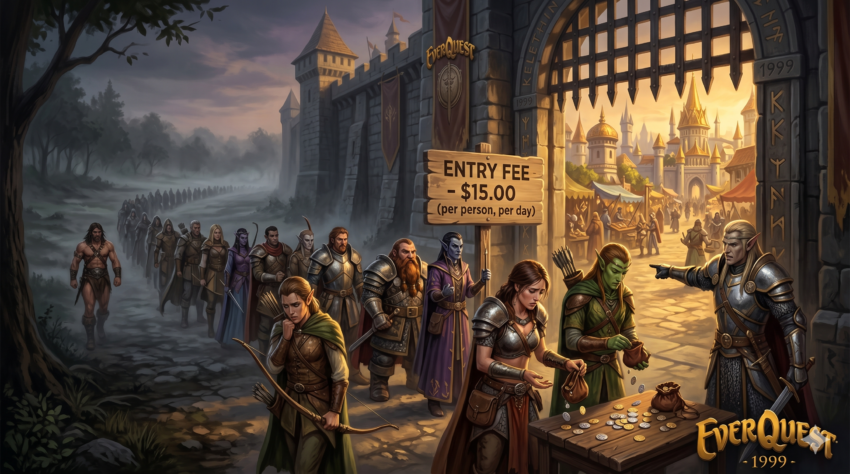
There’s a pattern in the MMO industry that nobody seems to want to admit. The biggest, most beloved, most expensive games in the genre all started with subscription models and all ended up free to play. Not because they wanted to. Because they had no choice.
Star Wars: The Old Republic was the most expensive game ever made when it launched in 2011. The studio was BioWare. The franchise was Star Wars. EA spent over $200 million developing it. It had everything going for it. By the end of 2012 — less than a year after launch — it converted to free to play because subscription numbers collapsed.
Lord of the Rings Online launched in 2007 with a subscription. Went free to play in 2010. Reportedly made more money in the first three months of free to play than the entire previous year on subscriptions.
DC Universe Online launched subscription in 2011. Free to play within 11 months. Population skyrocketed and the game has now been running profitably for fifteen years on a model that gives the entire game away for free.
Dungeons and Dragons Online, Champions Online, Star Trek Online, Age of Conan, Wildstar, Tera, RIFT, Aion, Everquest itself, Everquest 2 itself — all started subscription. All ended free to play. Wildstar is the cautionary tale of a game that resisted too long, kept its subscription, and shut down completely in 2018.
Now look at the games that launched free to play. Path of Exile is still going strong fifteen years later and got bought by Tencent. Warframe is still updating after twelve years. League of Legends became one of the biggest games on the planet. Fortnite is approaching $50 billion in lifetime revenue.
The lesson is so consistent it’s almost embarrassing. Subscription MMOs limp along until they convert. Free to play MMOs grow and last.
The audience you lose at launch is gone forever.
This is the part that doesn’t get talked about enough. When an MMO launches with a paywall and the population is thin, that’s not a problem you can fix later. The people who didn’t show up because of the price aren’t sitting around waiting to come back when the game goes free to play in eighteen months. They moved on. They found another game. They forgot it existed.
By the time SWTOR went free to play, the moment had passed. Most of the people who would have loved the game never came back. The ones who did show up later experienced a half-empty world that had already gone through its hype cycle without them. The launch population is the only launch population you ever get with full enthusiasm behind it.
Legends has one shot at this. Beta is happening right now. Launch is in July. Whatever the price is on day one is going to determine the population trajectory for the next two years.
The market has already chosen.
In 2025 alone the MMO genre lost Skyforge, Tarisland, Multiversus, Legends of Aria Classic, Dauntless, Kritika Zero, Star Wars Hunters, Spectre Divide, and several others. New World went into maintenance mode. The graveyard is full of subscription based and one-time purchase MMOs that couldn’t sustain populations.
Meanwhile the games people are actually playing — League, Fortnite, Path of Exile, Warframe, Genshin Impact — are all free at the entry point. That’s not a coincidence. That’s the market telling you what works.
The studios that figured this out early are still around. The ones that resisted are either gone or running smaller versions of what they used to be.
EverQuest fans aren’t a normal audience and that matters.
This is the part that should make Game Jawn especially confident in the free to play move. The EverQuest audience is uniquely loyal and uniquely willing to spend money on a game they love.
THJ proved this in real time. They were pulling in around $100,000 a month on donations alone. Not subscriptions. Not forced charges. Donations. People voluntarily giving money to a game they were already playing for free. That’s the EverQuest audience in 2024 telling you exactly what kind of monetization actually works for this player base.
Imagine if THJ had been able to legally monetize through cosmetics, character slots, premium services, expansion packs. The revenue ceiling would have been multiples higher than what donations produced. And not a single person would have been turned away at the entrance.
What free to play actually unlocks.
Once you remove the paywall, the upside opens up dramatically. Cosmetic skins. Character slots beyond the base allotment. Housing customization options. Premium subscriptions for QOL features. Expansion content that loyal players happily buy. Battle passes for seasonal cosmetics. Founder packs for collectors. Pet skins. Mount skins. Title unlocks.
None of that costs the developer anything to gate behind purchases because none of it affects core gameplay. And every single dollar from those purchases comes from a player who actually plays the game. That’s a far more sustainable revenue model than hoping to extract a monthly fee from people who logged in twice in the last two months.
The pricing decision isn’t locked in yet.
Beta is live. Launch is two and a half months away. Game Jawn has been listening to community feedback throughout development and has changed direction on multiple major systems based on what players have said. This is the moment to push hard on this one specifically.
Free to play is the only model the market has consistently rewarded for the last fifteen years. Every major MMO that started with a subscription either converted or died. The free to play games are the ones still standing.
EverQuest Legends has a chance to be something special. Don’t let a pricing decision at launch be the thing that gates it from reaching the audience that wants to play it.