Last updated: July 24, 2026 — beta closed July 21, launch is July 28. Includes the Unbound AAs announced July 23–24.
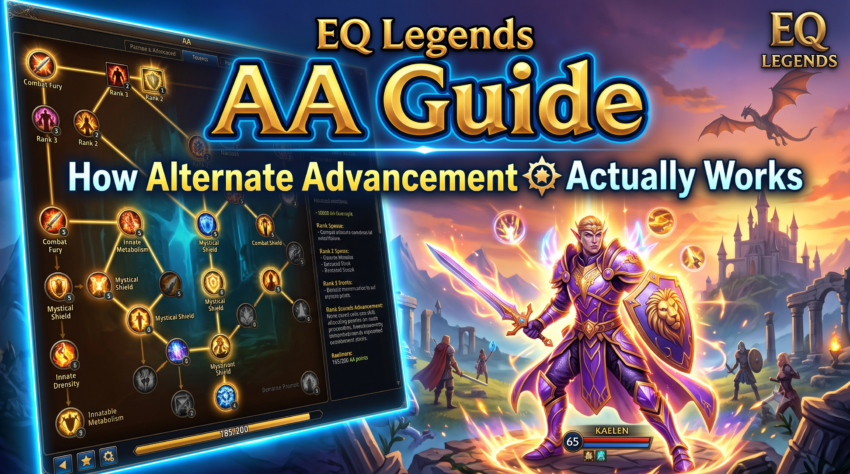
AA experience in EverQuest Legends comes in parallel with regular experience. The same kills feed both, and there’s no slider to flip between them. How much you get depends on the gap between your level and the level of what you’re killing — a yellow or red con pays a lot, a blue pays some, and a grey pays nothing.
Level 50 is the worst place to farm them
At 50, AA experience comes in at roughly 20% of the rate you were getting on the way up, and almost nothing still cons yellow to you. Unless you’re killing undead well above your level in the Hole or running raid targets on repeat, the points crawl.
Levels 10 to 25 are the opposite. Everything is red and yellow, kills are fast, and AA experience pours in. Motes drop most freely in that same bracket. Most players blow through it in an afternoon.
The loadout trick
Your AA pool belongs to your character, not to a class or a loadout, and your gear sits in storage when you swap. So at 50, drop into a fresh loadout running two low-level classes you haven’t leveled yet, wearing your endgame gear, keeping every AA you’ve already bought.
Everything cons yellow and red again. Kill speed is absurd — you’re a level 50 character’s gear and AA package wrapped around a level 12 class. You level classes you wanted anyway, and the pool is shared, so nothing gets stranded.
The Unbound AAs — free, and you get them automatically
Announced days before launch, one per class, autogranted. You don’t spend points and you don’t unlock them — they’re simply there. Ranks are listed low to high.
Rogue — Unbound Lethality. Poison duration up 10/15/20%, and enemy poison resistance drops by 25/50/75. Both halves matter: longer poisons mean more ticks, and lower resists mean fewer wasted applications. This is the biggest of the six for the class it lands on, because a rogue’s damage and self-healing both run through poison.
Monk — Unbound Alacrity. Current and maximum attack speed up 3/6/10%. The maximum half is the interesting one — haste caps at 75% and it’s easy to hit that ceiling with a bard or a haste item, at which point extra haste does nothing. Raising the ceiling lets the rest of your haste keep working.
Beastlord — Unbound Ferocity. 3/6/9% chance for your pet to flurry. Pairs with the improved warder mana regeneration also landing at launch.
Bard — Unbound Versatility. 5/10/15% chance to keep casting through a stun. Chain-stunning is what breaks casters at the higher difficulties, and a bard who keeps singing keeps the whole trio’s buffs, slow, and damage shield running.
Paladin — Unbound Life. Direct healing up 2/4/6%.
Shadow Knight — Unbound Drain. Lifetap damage up 2/4/6%. Alongside it, Leech Touch now converts Harm Touch into a lifetap rather than running as a separate ability, and Harm Touch gains a damage-over-time component that leeches too.
Enchanter hasn’t been finalised. The developers posted early notes describing an activated ability that stops your charm being broken or dispelled, and a second that spawns a decoy on the first hit you take, handing it your aggro while yours drops by 99%. Both were explicitly labelled as unfinished, so treat them as direction rather than fact.
Two more changes worth knowing even though they aren’t AAs: Frenzy and Cleave now reduce Rampage’s cooldown, which gives Warriors and Berserkers a faster loop into their big attack.
How the pool works
One pool, character-wide. Buy an AA while running a class and it works in every loadout that includes that class. Archetype and general lines follow you regardless of what you’re running.
Nobody has confirmed a way to reset or respec, so spend deliberately. Check the tabs every few levels — some abilities are gated behind a level requirement and don’t appear until you’re high enough, so a line that looked empty at 20 may have something in it at 30.
What to buy first
Stun resistance. Getting stunned interrupts your cast, freezes your movement, and stops your damage. Dungeon mobs stun constantly and from every angle. Four ranks gets you to about a 60% chance to shrug off a stunning melee hit from any direction. One caveat for launch: the developers confirmed a diminishing-returns system for stuns, mezzes, and fears was in the game but not working, and that it ships fixed. Repeated stuns of the same type should give progressively shorter durations and eventually immunity within a fight. That doesn’t make stun resistance redundant, but it may make the first ranks feel less urgent than they did in beta.
Extra spell gems. Every rank is another slot memorized. A trio with a priest class or a bard runs out of room fast — buffs, heals, heal-over-times, dots, resists, mez, and damage all want to be up at once. Start buying midway through leveling and max them eventually.
Quick Buff. Reapplies your whole buff set on a ten-minute cooldown. Pair it with saved spell sets, one for buffs and one for fighting, and the buff cycle stops eating your session.
Crit lines. Melee crit and the defensive lines are cheap and always on. For casters, the supercrit ranks scale the bonus from 60% up to 100%, and a crit on a proc or a lifetap returns full value.
Travel. Origin drops you at your starting city on about an 18-minute cooldown. Gather Party teleports your group to you roughly every six hours, which solves getting everyone into the same dungeon.
The ones that change how a build plays
Improved Mend takes a monk’s mend to about 30% of your health bar, and it crits for around 60%. Monks spend a few points in first aid to reach it.
Ambidexterity raises your dual wield rate by about 32%. On anything swinging two weapons that’s one of the biggest raw damage increases in the tree.
Crit heals — the healing boon and gift lines — let heals crit, and they pair with the Spellblade invocation.
Symphonic Aura auto-plays songs from your bottom gem slots, five at full ranks, without twisting a melody by hand and without fizzling mid-fight. Bards save for this first.
Pet Affinity lets your pet take your group buffs. On a pet build the pet stops dying.
Slay Undead procs constantly, and undead zones cover most of the good leveling dungeons.
Packrat cuts the weight of everything you carry by 30%. That matters for monks specifically, since their armor class bonus scales with how little they’re carrying.
Bane Strike unlocks through a monster family’s slayer achievement instead of straight purchase. After that, everything from that family takes an extra hit automatically. Grind the families you’re already killing.
Skip Life Burn. It looks big and sits behind a four-hour cooldown.
And don’t spend on anything the Unbound line already gives you — those are free.
The ogre question
Ogres get frontal stun immunity as a racial, which covers a good chunk of what four ranks of stun resistance buys. Some players skip the line entirely on an ogre and spend the points on spell gems or Symphonic Aura instead.
The racial only covers the front, though. In a dungeon you get hit from behind, from the side, and by three things at once. Ogres also don’t fit through a lot of doorways without a shrink, which usually means a shaman in the trio or a shrink click in a bag.
Rolling an ogre, buy stun resistance later. Rolling anything else, buy it early.
The AA potion
The shop sells a potion for around $5 that doubles the points on your next five AAs. It survives death and loadout swaps, can’t be dispelled, and burns its charges as you spend.
That’s about a dollar per point, and it doesn’t compound. The case for it is a first character rushing one early ability that changes how the class plays — a bard going straight for Symphonic Aura. Otherwise the loadout swap above earns more in an evening.
Building the trio you’ll spend them on? Score your combo at https://www.everquestguides.com/legends, and pair this with the 1–50 leveling guide and the motes guide at https://www.everquestguides.com.